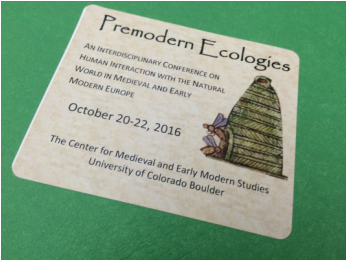
 I spent the last couple of days in Boulder, CO at the “Premodern Ecologies” conference organized by Scott Bruce of Boulder University’s Center for Medieval and Early Modern Studies (CMEMS), in the shadow of the Rocky Mountains. It truly was a colloquium or “talk-together,” with generous interlocutors gathered from a variety of fields, including History, Art History, Economic History, English, Italian, French, and others. I would be unable to do justice to the whole, so—without wanting to spoil the plot of anyone’s unpublished work—I present just a few points… What do I take away with me, on the ideas level? 1) The need for the plural when we talk of ecology/ecologies, as the conference title made clear, as Steve Mentz underscored in his very satisfying plenary reading of Hamlet that I hope will soon be in print, and as Richard Hoffman underscored in his closing remarks. Similarly, Anne Harris—in a nice paper on the stones of Montneuf, which dovetailed with my piece on Normandy limestone—brought out how the idea of the Anthropocene shouldn’t be about a switch between a fantasy of a pristine Edenic state and our now fallen situation. Steve, Anne, myself, and others all worked with the Anthropocene, in different ways, as a way of asking questions, of seeking out (as Steve put it) that which has been “hiding in plain sight” all along, as a mode of analysis, as central to that which makes the humanities so urgent these days. 2) The need for, and complex nature of, interdisciplinary study. One (of a good number of) reminders of this was Paolo Squatriti’s rich plenary about “worrisome weeds” that spanned continents (when/how/where does a plant become a weed?)—to think ecologically is to think in multiple languages and across borders. What Crosby showed for Europe and the New World vis-à-vis the Columbian Exchange, Squatriti showed for Medieval Europe, the Islamic Caliphate, and Asia. Without giving too much away, I won’t think of spinach, rye, and much more in the same way again. 3) Related to the above: different disciplines approach things in different ways. A noticeable trend of the conference tended to be that—and obviously, I oversimplify here—the literary scholars generally spoke more about premodern ecological anxieties and hesitations (Mentz, myself, Guevara, Brooks, etc.), tended thus to be more postsustainable in approach and outlook; whereas scholars from history and other fields often put the emphasis on premodern formulations of conservation (e.g. in medieval and early modern forests--Richard Keyser, Sarah Morrison, Abigail Dowling, etc.) This isn’t about pessimistic literary folk vs. the optimists, not another version of Charles Isherwood’s comment that theatergoers in NY want to walk into a theater to see a living room and four people complaining about life. This is much more about different methods, about different methods that must indeed work alongside each other, interrogate each other, as they did these last few days—no one field can tackle ecology! There is always a remainder, a counter-proposition, something that pulls against coherent and conclusive readings of a text. This is another sense of the “entanglement” that came up at multiple points, esp. in Anne Harris’s talk on “Entangled Ecologies.” 4) The nonhuman—and this comes as no surprise—was at the heart of our group reflection: plants (Keyser, Morrison, Dowling, Guevara), stones (myself, Anne Harris), nonhuman animals (Nodin de Saillan on the evolving category of “vermin”; Roya Biggie’s talk on beetles via Dürer, Moffet, and Shakespeare). As Renée Trilling showed, it’s about connecting the human and the cosmos; as Danielle Joyner showed, it’s about connecting living spaces, a plant, a plan, a whole world; as Manon Williams showed, it’s about forests and desire and—in a Michel de Certeau—how we create spaces and places. 5) Harriet Archer’s paper on John Higgins’s Histories of King Forrex (1574 and 1587), brought out, inter alia, the overlap between mining and humanist practices of “digging for wisdom”—which reminded me of a gathering of forces that involved myself and Emily Apter around mining and data mining at NYU last year. In other words—and this perhaps relates back to the question of interdisciplinarity and different methods—we must be aware of our own “ecologies of reading”—Do we mine? Do we cultivate? Do we create waste? Are we aware of entanglements or do we write them out of the story? What do our extraction machines do? Are we responsible “diggers”? Etc. 6) Prompted by a discussion at the bus stop this morning, waiting for the AB Airport bus, with Tobias Hrynick, who gave a rich paper on mill dispute and waterpower in the Latin Kingdom of Jerusalem, I realized that our conference evoked various elements, but more water and earth, than air and fire. In the light of Cohen’s Elemental Ecology, I wonder why—but don’t have an answer here. The conference clearly went more in the direction of the more solid/touchable elements. Does this teach us something? 7) The opening Willard Lecture by Miri Rubin (Queen Mary) on “The Environment of Medieval Cities: Diversity, Identity, Social Fabric,” walked us through many medieval cities, and gave perspectives on how medieval Britons lived with/tolerated those who came from elsewhere. The urban theme stayed with us throughout and kept the question of human difference, social justice, and models and counter-models for living-together in our minds throughout. Much more happened that I don’t recount here. Many other fabulous papers will remain with me. And there will, I’m sure, be future extensions of conversations begun here. A pretty good emblem for the past couple of days might be what I saw in the Natural History museum during one of the breaks (the sun was too hot to stay outside in the Shakespeare theater!), namely a petrified tree trunk—it was Family Day at the museum and children were staring at the trunk, touching it (as a sign invited), marveling at how stony cold it was, how much it looked like a tree even though it “wasn’t”: touching physical reality, struggling to name it because “it” challenges us right back, enjoying that contact, sharing it with others, even as we remain anxious. There is a difference between “idealizing nature” and “wondering at the physical”—the former, as they once said of self-pleasuring, leads to blindness; the latter to full engagement. 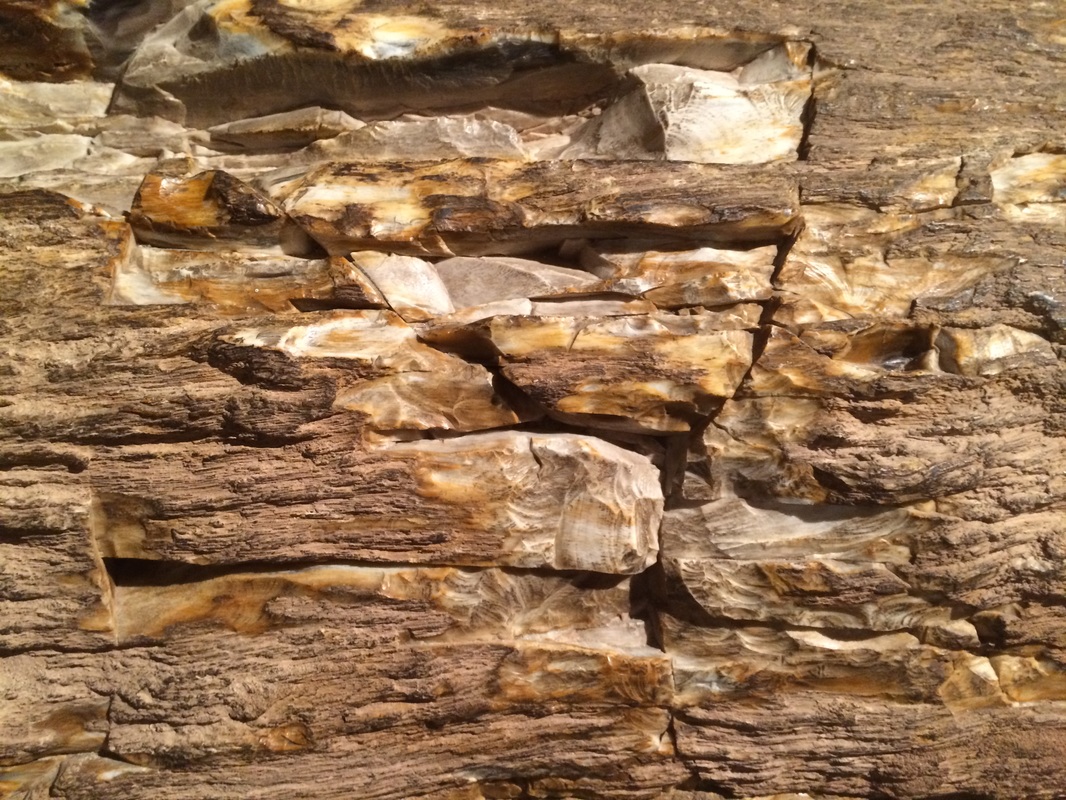 Comments are closed.
|
Project THE HUMANIST anthropoceneis a thought archive and workspace of Phillip John Usher (NYU) at the crossroads of early modern humanism and the problems and insights of the Anthropocene. Main Research Page. Categories
All
Archives
May 2016
Related SitesASLE (Association for the Study of Literature and the Environment)
Environmental Humanities (journal) Resilience (A Journal of the Environmental Humanities) All text and images quoted from other sources used according to fair use. If I have used one of your images and you would like me to remove it, please email me.
|
 RSS Feed
Photo used under Creative Commons from Philliz88
